12 teaching strategies that ELA teachers should be aware of
by Alex Milledge
A variety of strategies is needed to succeed as a teacher in the classroom. Some strategies are more intensive than the others, but it is important to start from groundwork strategies and then suggest specific activities that teachers can do in the classroom.
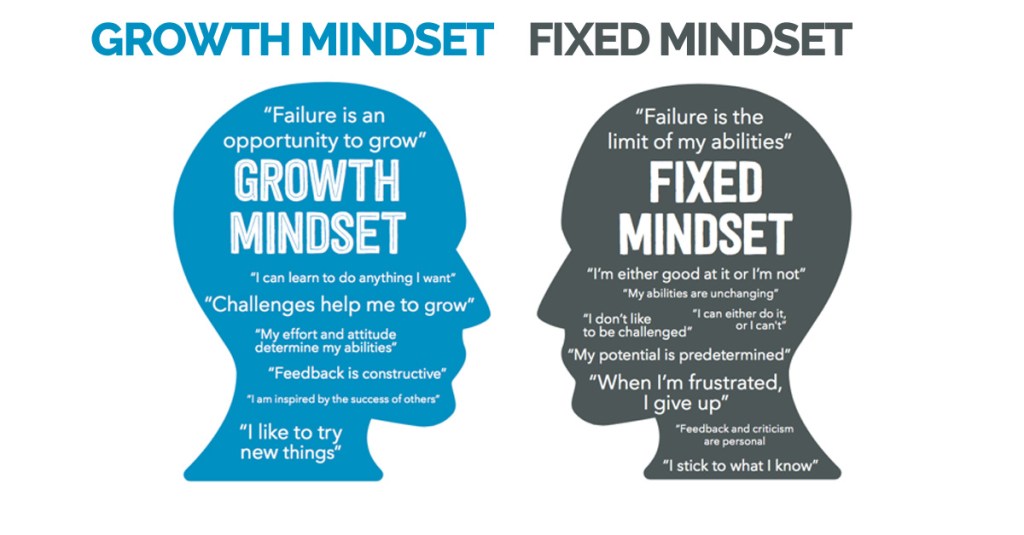
- Growth Mindset
Growth Mindset is a psychological strategy that focuses on how student’s inner dialogue and self-esteem affects their performance. For instance, some students may say to themselves that they are “just not a math person” or “I will never get Math.” Teachers must learn to challenge student’s thinking to be more open and positive towards accomplishing learning objectives. Instead of “I will never get math”, a student can say “I’m not getting it, let’s try another strategy”, “What do I need to understand to accomplish this problem”, “I can be good at Math if I apply myself”. Growth Mindset looks to change student’s inner dialogue from fixed, static, and absolute statements about their ability, to open, flexible, and positive statements (Stern et Al, pg. 30, 2017).
2. Journaling
Journaling is a great beginning of class activity to allow students to access prior knowledge and get motivated for the lesson. As an English/Language Arts teacher, I use journaling as a warm up for my students. I usually have a prompt on the board and I give students 5-10 minutes to answer the prompt. I discuss the prompt afterwards and then dive into my lesson. Journaling can be used in any discipline (Stern et Al, pg. 48, 2017).

3. Divide and Slide (aka Philosophical Chairs)
Divide and Slide, or what I call “Philosophical Chairs”, is a class activity where the teacher makes a state that can be agreed or disagreed with. Students are to line up on a designated side of the room that is agree and another side that is disagree. There is also some space allowed to be unsure which is in the middle of the room. Students align themselves with agree or disagree and then work with other students to make the best argument for their side. They are supposed to draw students who are undecided or make the other side change their minds (Stern et Al, pg. 50, 2017).
4. Gallery Walk
A gallery walk is where the teacher uses poster paper and assigns topics to groups. Groups are supposed to become experts on their concept and teach other students. Groups rotate between stations and students are supposed to write down what they know about a subject and build upon other student responses. This is a great activity to get students moving around the classroom (Stern et Al, pg. 51, 2017).
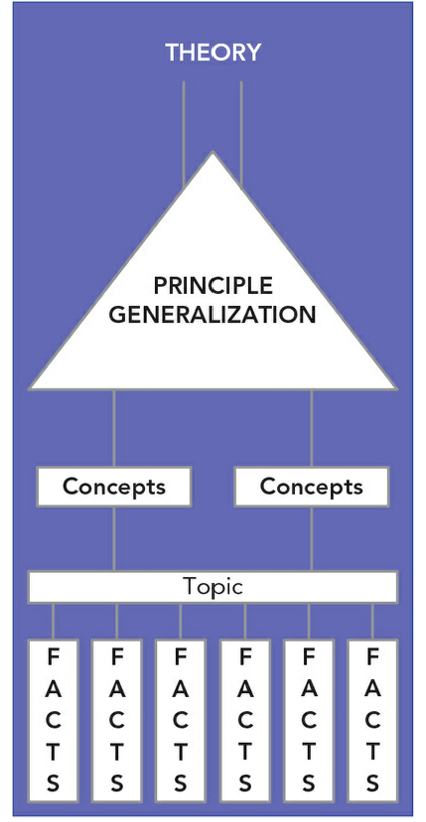
5. Concept Attainment
Concept Attainment is a four step process by which students create their own generalizations. The first step is to investigate examples. The second step would be clarify examples and distinguish from non examples. The third step would be to confirm critical attributes. The final step is to reflect and synthesize information (Stern et Al, pg. 53, 2017).
6. The Cycle of Conceptual Inquiry
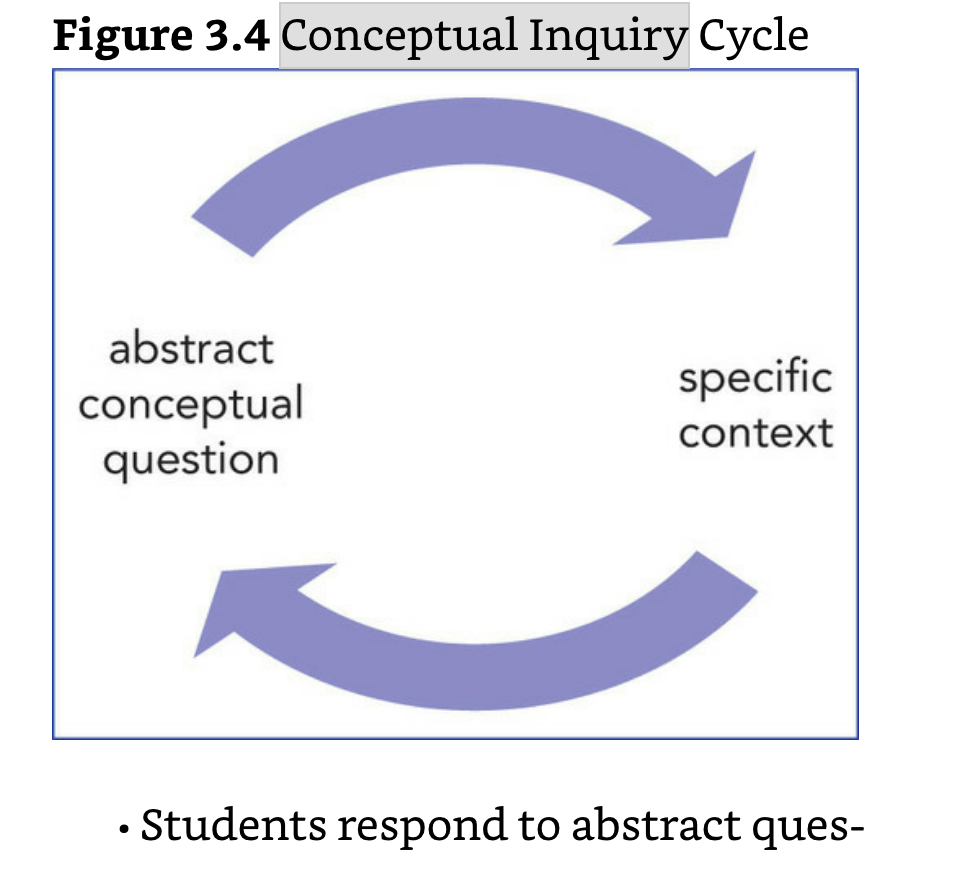
The cycle of conceptual inquiry shows how conceptual questions should be given a specific context. The teacher asks a question in which students are initially confused by. The teacher clarifies by giving a specific example. Students then come up with their own examples, which the teacher negates. Students are allowed to come up with own generalizations (Stern et Al, pg. 59, 2017).
7. Project based learning
Project based learning is different from merely assigning projects in class. Project based learning is when students work on questions or experiments for an extended period of time. Students are encouraged to use critical thinking and problem solving skills to work towards completing a project with the teacher providing scaffolding along the way. Students have an input or choice on how the project is completed and how they should adjust (Stern et Al, pg. 74, 2017).
8. Personalized Learning
Personalized Learning is an approach to student learning that emphasizes giving students the option to study whatever they like, how they like. I find this method to be helpful because students learn at a variety of paces. Some students learn faster than others, some learn slower. In your lesson plan, you should scaffold for the variety of speeds that students learn at and help make connections explicit. For the more intellectually gifted students in the class, you could assign work that would help conduct research (Stern et Al, pg. 83, 2017).
9. Vary your assessment methods
Teachers need to vary assessments methods. Teachers should not use the same assessment repeatedly. As an ELA teacher, I have to use a vary of assessment methods to test for understanding. I like using long form responses as well as essays, and I try to stay away from multiple choice tests as much as possible. Varying assessment methods allows for more diverse insights and data from students (Stern et Al, pg. 107, 2017).

10. Effective feedback
Teachers should provide effective feedback whenever possible. For English/Language Arts teachers, teachers read essays and should give feedback whenever possible. Feedback should not be generic or hasty, but should show that the teacher read the paper, understood the points, and provide feedback to make the paper stronger. Teachers should give personalized feedback wherever possible (Stern et Al, pg. 107, 2017).
11. Use rubrics
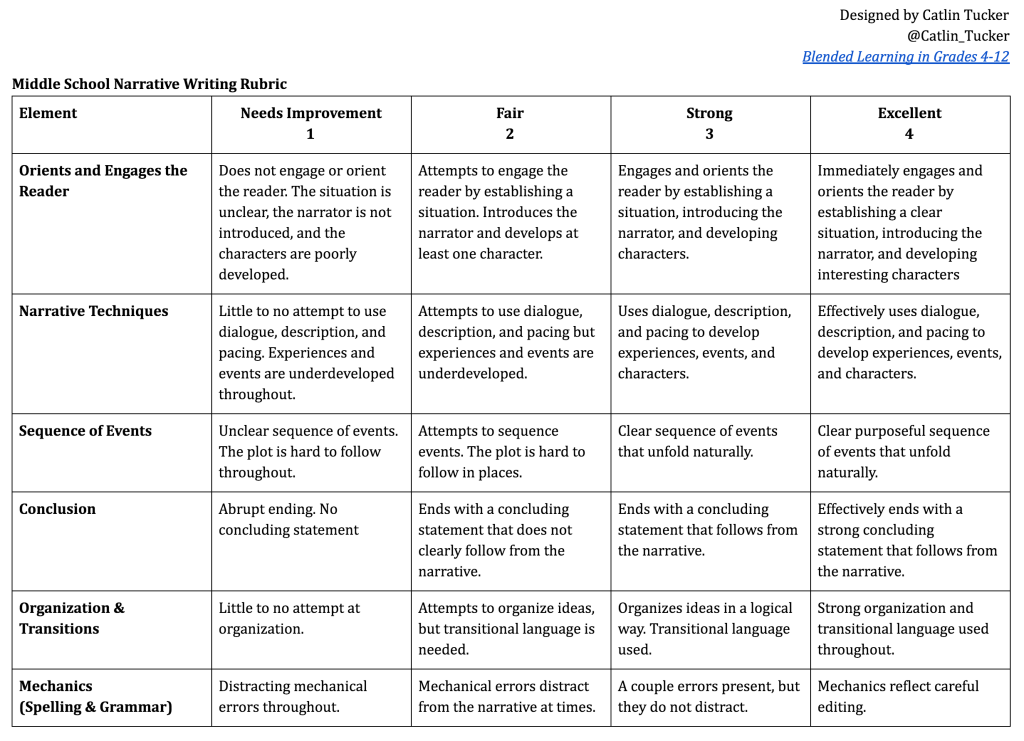
Rubrics are the best way to communicate expectations to students and grades using an objective metric. By using rubrics, students can understand that they need to do to achieve the highest grade possible. The rubric becomes the independent standard by which the teacher grades the assignment. Rubrics communicate what is considered good work and if the student receives that less than expected grade, they can refer to rubric to see what part of the assignment they did not do well on (Stern et Al, pg. 111, 2017).
12. Take steps to Combat low expectations in students
Teachers should combat low expectations in students in various ways. Teachers should reframe student confidence using Growth Mindset to help change student’s self-concept and their ability to achieve. Teachers should question racial stereotypes that presuppose student success for particular populations. Teachers should communicate clear expectations and also hold high expectations for student performance. Teachers should exhibit unconditional positive regard for students and not speak to students in ways that seem dismissive or derisive towards students (Stern et Al, pg. 121, 2017).

Resources
Stern, J. H., Mohnkern, J., & Ferraro, K. F. (2017). Tools for teaching conceptual understanding, secondary: Designing lessons and assessments for deep learning. Thousand Oaks, CA: Corwin, a SAGE Publishing Company.

