Here is an article written about the debut of Fullerton College’s Spanish Speaking News Publication “La Antorcha” written by Alex Milledge in 2011.
ITL 608 Assessment Assignment: Chapter 1 1984
On May 24, 2020 I created a summative assessment for my Grade 12 English class who is reading “1984” by George Orwell. The quiz is based on content in the first chapter of the novel which questions students on events in the chapter and relevant literary devices employed. The summative assessment is a Google Form that is meant to be administered to students via google classroom and submitted to the teacher to grade. The assessment will be administered after students finish reading Chapter 1 and any class discussion on the Chapter.
When creating the assessment, the California Common Core State Standard was CCSS.ELA-LITERACY.RL.11-12.10 which says that “At the end of grade 12, read and comprehend literature, including stories, dramas, and poems, at the high end of the grades 11-CCR text complexity band independently and proficiently.” Another standard I had in mind was CCSS.ELA-LITERACY.RL.11-12.9 “Demonstrate knowledge of eighteenth-, nineteenth- and early-twentieth-century foundational works of American literature, including how two or more texts from the same period treat similar themes or topics.” By reading 1984 and asking specific questions about the text, students are being tested on deciphering events, characters, and literary devices that are used in complex books and novels. In my quiz, I asked to recall events that happened in the chapter and then explain literary devices employed in the novel.
The assignment that I created is intended as a summative assessment based upon reading and discussing Chapter 1 of 1984. A summative assessment is any assessment that is used after instruction has happened in order to gauge student understanding and comprehension. A summative assessment could be an exit ticket or an end of chapter/unit lesson (Gordon and Byrd, 2018, pg. 289). This assessment will be administered after assigning reading for homework and discussing the chapter in class. I would also give students a reading comprehension guide in order to frame student understanding and point key events and motifs as the novel develops.
In order to provide scaffolding and support to SPED learners, ELs, and students with Social-Emotional issues, I chose a Google form to administer my summative assessment in order to have students type in answers and grade them online without using a paper-based assessment. In order to prepare students for the quiz, I would give them a reading comprehension packet in order to direct student attention to key points and developments in the novel. I would also introduce vocabulary and literary devices in order to help students think about a chapter. I would also discuss the chapter and make connections explicitly so students with Autism who have problems with making complex associations clear. For ELs to make events clear as they unfold is also helpful and to scaffold using vocabulary to build new vocab is essential. Students with social-emotional difficulties will have the reading comprehension guide to study in order to reduce anxiety about questions asked on the quiz regarding plot and storyline.
I will use the assessment to gauge student comprehension of the material. I will use it to adjust my instruction for the next chapters if necessary.
Link to assessment here: https://docs.google.com/forms/d/e/1FAIpQLSdNDLytqwW_Oiosbmcn16d-UXg-j29WjlBXoeJpwmtErCWa_w/viewform?vc=0&c=0&w=1
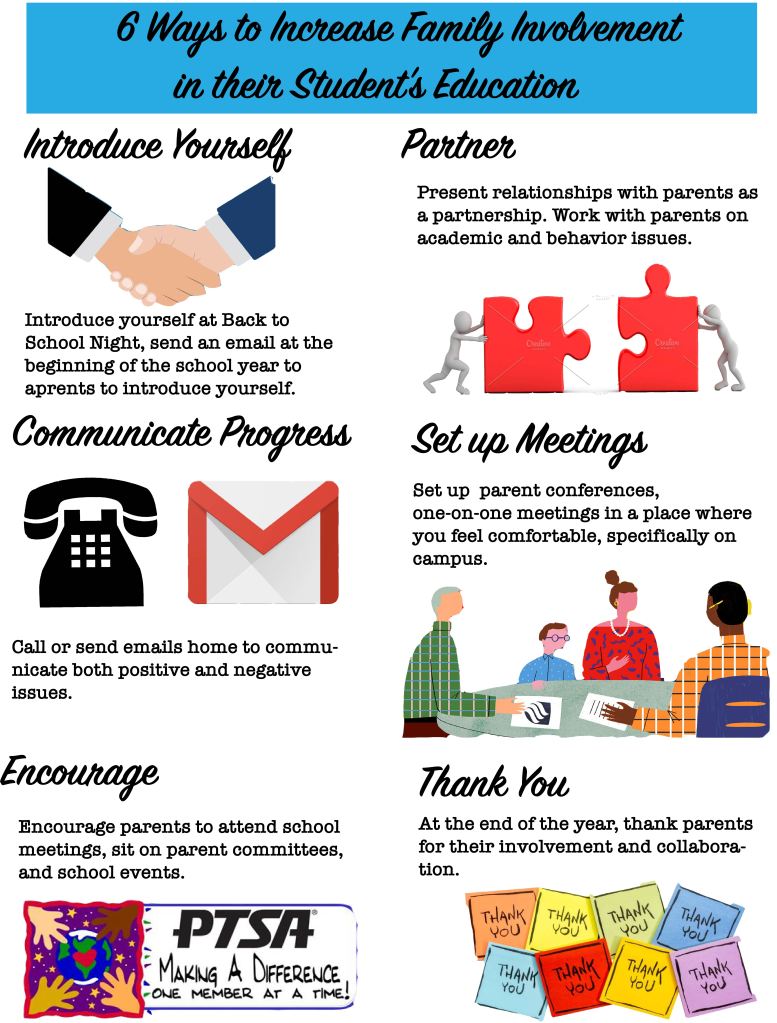
ITL 604 6 Ways to Increase Parental Involvement
Alex Milledge Philosophy of Education
The Greek philosopher Socrates famously declared in his defense speech that “the unexamined life is not worth living”, that a life of passivity and lack of examination of one’s personal beliefs is undesirable and inferior to one of examination and constant questioning of one’s beliefs. In my education and career as a teacher, philosophical inquiry and questioning has been an effective way to deliver and relate content back to the student. Using guided questions, personal connections to literature should be made and brought back to the student to think deeper when reading content. Once those connections are made, reading becomes pleasurable and relatable to the student.
Coming from an abusive, toxic household, school was a refuge for me. School provided structure and a place for me to go to get away from my house. Since my elementary was a magnet school, I was inspired by my teachers to strive for academic excellence. My favorite elementary teacher was my 6th grade teacher Mrs. Dyer. In 6th grade, we studied the ancient civilizations including Mesopotamia, Egypt, Greece, and Rome. I enjoyed studying Greek Mythology and the insights that the Greeks had about spirituality, and from thereon considered myself a Greek in my worldview.
As a high school student, I felt unchallenged and received no praise or commendation from my teachers. It wasn’t until I did journalism as an elective my senior year that my journalism advisor acknowledged my writing ability. From her encouragement, I decided to study Journalism when I went to college. I attended Fullerton College where I studied Journalism but later switched to Philosophy because of the impression that my Intro to Philosophy instructor left on me, Dr. Holden. Outside of Socrates, I thought that Dr. Holden was the wisest man that I ever met. Philosophy taught me to value education for its own sake and posed timeless questions which opened my mind up to enlightenment. In a survey from Teachers, School and Society pgs. 404-405, I noticed that I rated statements that dealt with learning for its own sake and that education should relate to the great thinkers of the past and timeless questions. Philosophy is not taught as a separate subject in K-12 administration whereas in the rest of the world, Philosophy is taught to high schoolers. It should be an important part of education reform to correct this and teach Philosophy in the curriculum.
In my education, I have also had some terrible experiences with educators. The most pertinent example would be my baseball coach from high school, Coach Price. According to the Code of Ethics of the American Association of Educators, Educators have a responsibility towards their students to “2. …Not intentionally expose students to disparagement” and “4. The professional educator makes a constructive effort to protect the student from conditions detrimental to learning, health, or safety.” Coach Price took over my high school’s baseball program in 2008 when I was a sophomore and in order to gain the trust of the other players, he put down players and make jokes at their expense. Coach Price let hazing and upperclassman hierarchy rule the class. My brother and I were bullied for the first time in our lives in the program because we were jittery and anxious on the field. We were facing a cornucopia of family issues off the field and instead of our teammates asking “What’s wrong?A”, players would say “Rattled!” as though they had gotten into our heads. Coach Price did not take any notice to this and by omission condoned this kind of behavior. Because of him and his coaching staff, I have wanted to become an educator so that I could be a better administrator than the ones at my school.
Education has been an avenue for mental, emotional, and spiritual growth for me. Without education, I would not have the life that I have now. Education beautifies the soul and gives me purpose. It allows to practice my philosophy and interact with students in asking timeless questions which are not often asked within the regular classroom environment. One of the most encouraging comments that I have received since becoming a teacher was in my first year, a student came up to me and said “We wouldn’t have learned this with our regular teacher.” Teaching Philosophy as a hidden curriculum has strengthened my student learning outcomes.

